Small roofs, high stakes
A bank branch is a modest building with an outsized sensitivity to water. The roof itself is usually a compact low-slope deck, a fraction of the square footage of a store or a warehouse, but it sits on a corner lot where everyone driving by sees the building, and it covers a vault, a server room, and a customer floor where a single ceiling stain on a Monday morning is a problem. We roof financial buildings across Billings, from the branch banks and credit unions strung along Grand Avenue and the King Avenue and 24th Street West retail corridors to the downtown financial offices near the Montana Avenue core. The footprint is small. The tolerance for a leak is smaller.
More going on up top than the size suggests
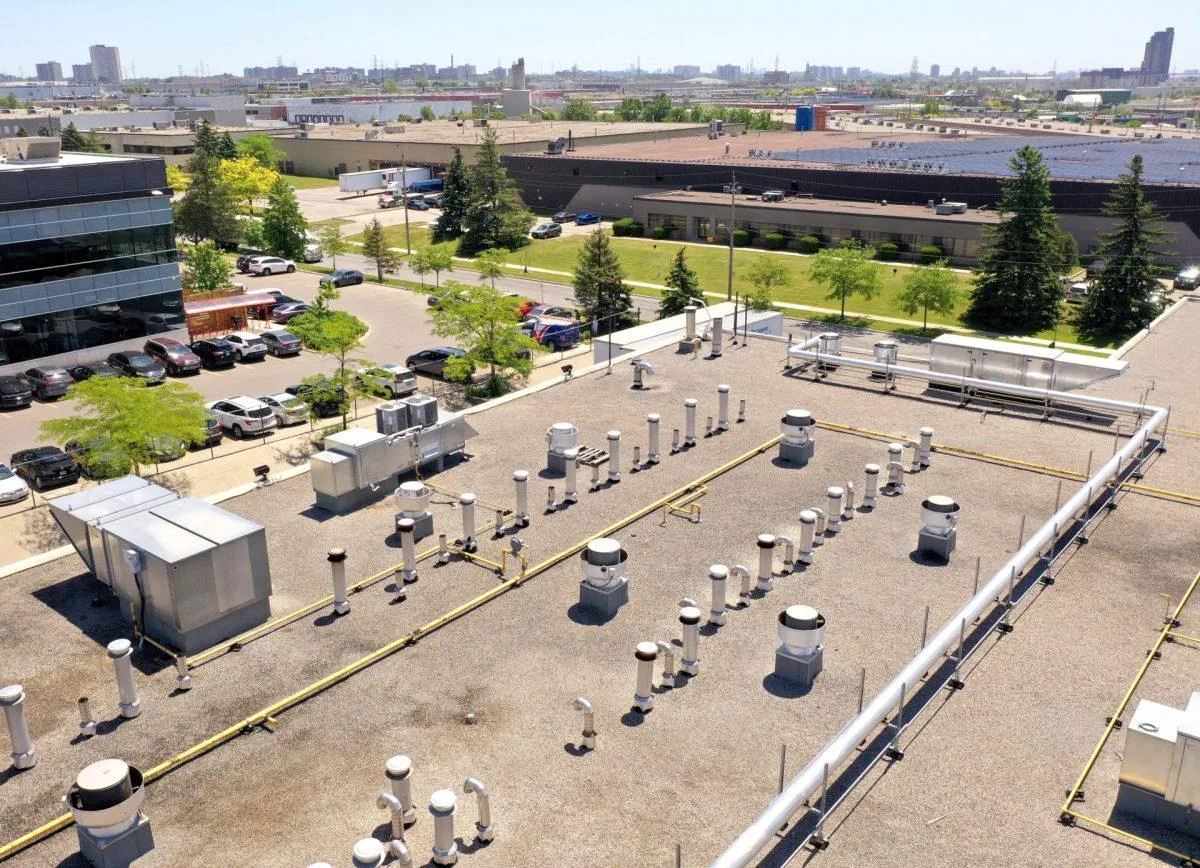
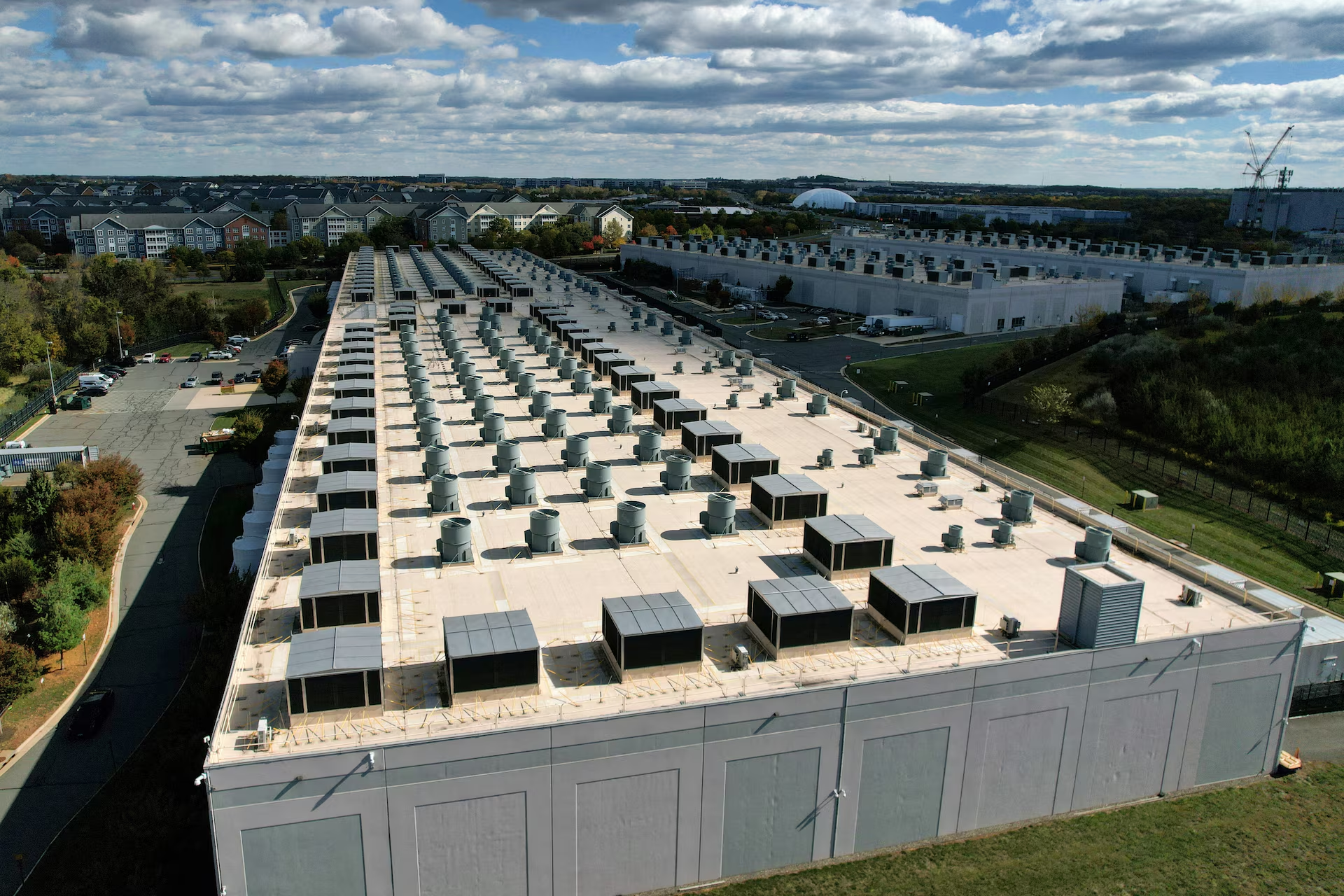
Walk a bank roof and you'll find a surprising amount packed onto a little deck. There's the rooftop unit or two for the branch, exhaust for a generator transfer room, condensers or a precision air-conditioning unit holding the server room at temperature, and the connection out to the drive-through canopy. For the square footage, the penetration density is high, and on a high-visibility building the parapet and edge metal also have to look sharp, a wavy fascia or a stained parapet reads as neglect on a building whose whole job is to project stability. We detail the flashings and the edge to hold up cosmetically as well as keep water out.
The drive-through canopy is where the leaks live
If a branch has a chronic leak, the odds are it's at the drive-through canopy, not the main roof. That canopy is a separate little structure tied back into the building, and the connection where its roof meets the wall takes a beating: thermal cycling as it heats and cools faster than the main mass, overspray and grime off vehicles, and differential settlement between the canopy footing and the building. Standard retail flashing details don't survive that long-term. We treat the canopy transition as its own line item on every bank project, evaluated separately, and if it's deteriorated, re-flashed with a detail built for the movement instead of getting smeared over when the field membrane is replaced. Replacing the main roof and leaving that joint alone is how a branch ends up calling about the same drip a year later.
What a branch roof walk covers
- The drive-through canopy-to-building connection, scoped on its own
- Rooftop units, generator exhaust, and the server-room cooling penetrations
- Parapet, coping, and edge metal condition on the visible faces
- ATM kiosk and signage penetrations
- Drain and scupper function on a small roof where one blockage floods fast
Security shapes the schedule before the roofing does
Financial buildings come with access rules most commercial property types don't. Crews get badged, vault-adjacent areas may require an escort, and security cameras document contractor activity on the roof and around the building. None of that is a surprise we spring as a change order, we build the credentialing timeline and any escort requirements into the bid schedule from the start, identify the vault and server-room locations off the building drawings before mobilizing, and confirm with the security team that no vibration or temporary access change touches active operations during the work.
Working around the teller line
Branches run set business hours, often Monday through Saturday, with customers and staff underneath the whole time. We concentrate the loud, disruptive work, tear-off, the active membrane installation, into off-hours and weekends wherever the scope allows, and confirm the roof is dried in watertight before the doors open each morning. The branch manager and the corporate facilities contact get the work windows, the noise limits during customer-service hours, and the access plan up front. A small roof helps here: the scope is usually short, so a branch reroof can often be staged to wrap with minimal interruption to the business below.
Ice and a parapet that holds water
A small branch roof in Billings is usually ringed by parapets on all four sides, which makes it a shallow tray that has to drain through a handful of openings. In a freeze-thaw winter that's a problem if the slope is lazy or the drains and scuppers are undersized: snowmelt ponds against the parapet, freezes overnight, and works at the seams and the base flashing right where the wall meets the roof. On a building with a vault and a server room directly underneath, that's the last place you want a slow leak. We make sure the insulation and any tapered build route water to the drains, keep an overflow scupper as a backstop so a single iced-over drain doesn't flood the tray, and detail the parapet base and coping to take the ice cycling without opening up.
Keeping a small roof out of trouble
The cheapest roof problem on a bank branch is the one caught on a walk instead of at the teller line. Small roofs fail fast when they fail, there isn't much field to absorb a blocked drain or a split boot before water finds its way in, so a couple of inspections a year, in the fall before snow and again after the thaw, earn their keep. We clear the drains and scuppers, recheck the drive-through canopy joint, look over the rooftop-unit and server-cooling penetrations, and touch up sealant and flashing before any of it becomes a ceiling stain over the lobby. For portfolio owners we roll that into a standardized maintenance report across every branch so capital planning isn't a guess.
Portfolios and single branches
A lot of financial real estate in Billings is held in portfolios, a regional bank with a string of branches, or a national institution running locations through centralized facilities management and an approved-vendor program with national-account pricing. We work inside those structures for portfolio accounts, with standardized scoping and documentation and a single project-management contact for the corporate team, and we work direct with the community banks and credit unions managing a building or two on their own. Either way the closeout package is consistent: insurance and license verification before mobilization, a pre-construction safety plan, daily work and dry-in reports, manufacturer warranty registered in the owner's name, and the final permit and inspection package for the file.
Common questions
How do you schedule around branch hours?
We push tear-off and active installation into off-hours and weekends where the scope allows and confirm watertight dry-in before the branch opens each morning, with work windows, noise limits, and any security escort coordinated with the branch and corporate facilities ahead of time.
What about the drive-through canopy?
It's scoped as its own flashing item and, if deteriorated, re-flashed with a detail made for the differential movement it sees. It's the most common chronic branch leak and it's never fixed by replacing the field membrane alone.
Can you work over an active vault or server room?
Yes. We locate the vault and server room off the drawings before mobilizing, sequence those roof zones during approved windows, and confirm with security that no active operations are affected by vibration or access changes.
Do you handle multi-branch programs?
We do. Portfolio programs get standardized scoping, documentation, and pricing across locations with a single project-management contact for the corporate facilities team.